Stinging insect activity in St. Louis County concentrates heavily between late June and mid-October. Fertilized queens emerge from winter diapause beneath loose cedar shingles, rock retaining walls, or attic rafters to…
Stinging insect activity in St. Louis County concentrates heavily between late June and mid-October. Fertilized queens emerge from winter diapause beneath loose cedar shingles, rock retaining walls, or attic rafters to establish colonies that expand to 1,000 to 4,000 workers by August. In hillside neighborhoods like Piedmont Heights, Duluth Heights, and Kenwood, prevailing winds off Lake Superior push aerial yellowjackets into protected architectural soffits, fascia corners, and porch overhangs. Historic frame homes along Chester Park and Congdon Park, often featuring double-hung wood sash frames and unvented stone foundations, present unsealed pathways directly into wall insulation. Ground-nesting species regularly settle along sandy soil banks on Park Point or within undisturbed brush lines flanking Spirit Mountain.
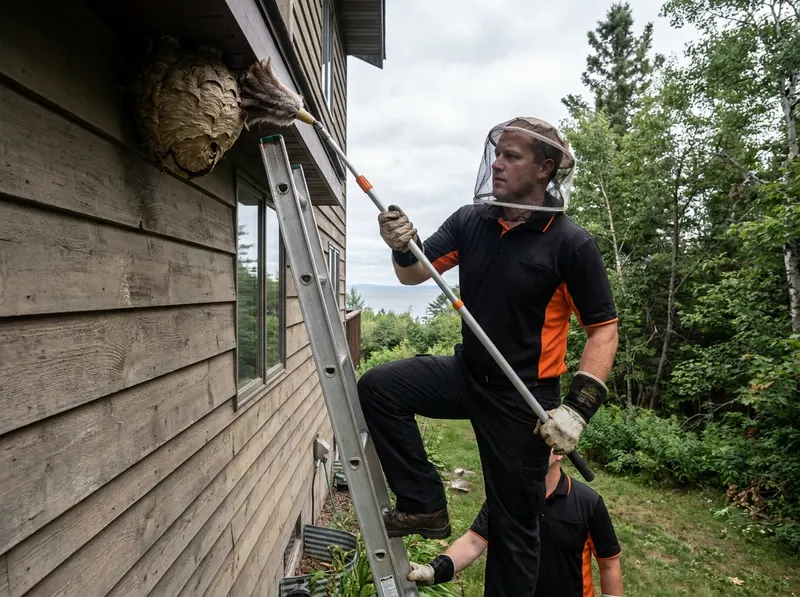
Wasp and hornet nest removal requires methodical species determination before applying mechanical or aerosol knockdown treatments. Bald-faced hornets construct enclosed, football-shaped paper envelopes suspended from tree canopies or upper story dormers, requiring directional residual pyrethroids or low-impact botanical concentrates delivered at high pressure. Ground-nesting yellowjackets demand deep-void perimeter liquid saturation or micro-dust injections into subterranean tunnels to neutralize the reproductive core without triggering defensive dispersal swarms toward living spaces.
A single structural sting hazard differs fundamentally from systemic structural pests. While wood-destroying carpenter ants compromise structural framing over years, active stinging colonies generate acute physical risks to occupants, domestic pets, and exterior maintenance crews. The operational protocol involves three distinct steps: 1. Locating the primary point of ingress and mapping the nest perimeter behind sheetrock or siding using thermal imaging. 2. Suppressing defensive activity with localized application equipment to keep workers from penetrating living spaces. 3. Physical extraction of the envelope followed by silicone-sealant closure of the void.
Removal protocols vary by nest location. Exposed paper wasp umbrellas beneath first-story gutters in West Duluth, Lincoln Park, or Lakeside-Lester Park permit complete manual removal within 45 minutes. Enclosed wall-cavity nests in Morgan Park brick structures require targeted drywall or mortar exploration. In situations where an active nest resides within an uninsulated second-story knee wall near UMD, opening interior plaster involves containment tarps and industrial HEPA air scrubbers to trap dislodged dander, venom proteins, and defensive stragglers. All on-site assessments verify complete queen removal before mechanical sealing occurs.
Every job gets a firm, written price after a free on-site visit.
Tell us about your wasp and hornet nest removal job in Duluth and we'll send a clear, written quote, usually the same day.
 Virelza Pest Control