Carpenter ants do not ingest structural wood like subterranean termites; instead, worker ants mechanically excavate moist cellulose to construct smooth gallery channels for brood rearing. In Duluth's freeze-thaw…
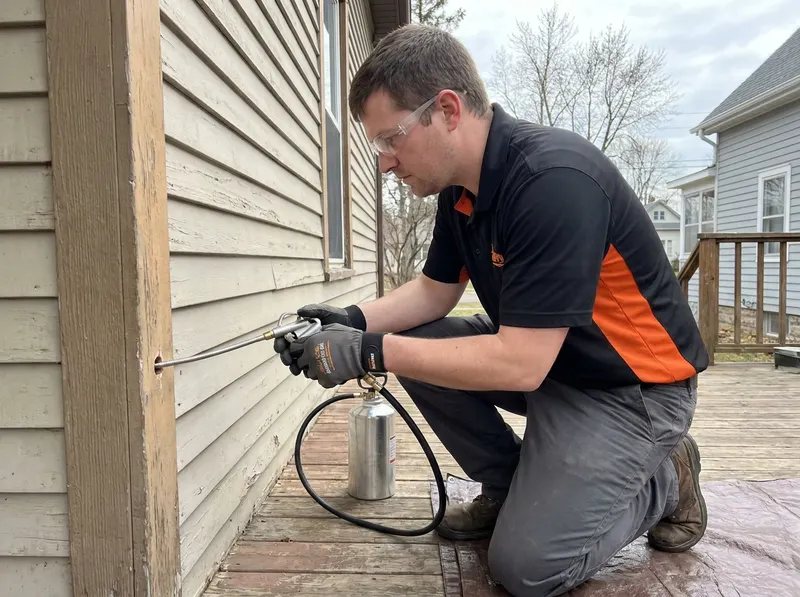
Carpenter ants do not ingest structural wood like subterranean termites; instead, worker ants mechanically excavate moist cellulose to construct smooth gallery channels for brood rearing. In Duluth's freeze-thaw environment, high humidity from Lake Superior and freeze-damaged vapor barriers routinely cause moisture retention behind exterior wall sheathing. Older craftsman and timber-framed residences throughout Congdon Park, Chester Park, and Lakeside-Lester Park are especially prone to satellite colony establishment inside foam insulation boards and damp wall studs adjacent to window flashings, roof valleys, and crawl spaces. While broadcast perimeter barrier sprays control surface foraging trails along foundation blocks, they fail to penetrate enclosed interior cavities. Injecting localized dry insecticidal dust directly into these structural voids uses the ant colony's natural grooming behavior to circulate the active material deep into the primary nesting hub.
Decision-fit considerations require distinguishing between exploratory perimeter foraging and active internal nesting. If scattered individual ants appear solely on kitchen countertops during early spring, targeted perimeter exterior treatments and moisture mitigation resolve the issue without drilling. When homeowners observe sawdust-like frass piles containing insect body parts along floorboards, hear faint crinkling sounds inside drywall cavities during quiet evening hours, or encounter winged reproductive swarmers indoors, structural void treatment is mandatory. The procedural trade-off involves placing micro-access holes into drywall or trim versus permitting unmitigated gallery excavation to hollow out load-bearing wall studs, sill plates, and headers.
Structural void treatment follows an exact three-step engineering protocol. Step 1 involves identifying nesting coordinates using moisture meters and acoustic listening devices along baseboard lines and plumbing chases. Step 2 requires drilling discrete 1/8-inch inspection holes through baseboard lines, outlet borders, or unfinished crawlspaces, followed by the measured pneumatic injection of non-repellent pyrethroid dust or pressurized botanical active compounds. Step 3 seals all pilot holes with color-matched structural wood putty or acrylic caulk, leaving no exposed open access points for domestic occupants or household pets.
Every job gets a firm, written price after a free on-site visit.
Tell us about your carpenter ant void treatment job in Duluth and we'll send a clear, written quote, usually the same day.
 Virelza Pest Control